
Written and curated by Gabrielle Patterson
Introduction
Boston’s history is often told as a story of revolution, intellect, and abolition, but tucked between those familiar narratives are lives that were far more complicated, intimate, and quietly queer than the textbooks let on. This exhibit invites you to step into that hidden Boston, where George Middleton commanded Black militia troops by day and built an unconventional home life on Beacon Hill by night; where a young and determined Edmonia Lewis arrived with nothing but ambition and a belief that she could carve a life a “stone man” for herself; and where the early years of Angelina Weld Grimké unfolded in a city that shaped both her identity and her deepest, most private longings. These stories remind us that queer Black history isn’t new to Boston; it has been here all along, living in shared homes, artist studios, abolitionist circles, and in secret love letters. By bringing their complexities and contradictions into the light, we’re not only recovering forgotten lives; we’re also expanding our understanding of what Boston’s past and future can hold. Welcome to the layers of Boston you weren’t taught, but deserve to know.
George Middleton: Freedom Fighter, Community Builder, and Quietly Queer
"Freedom is desirable, if not, would men sacrifice their time, their property, and finally their lives in the pursuit of this?" — George Middleton, 1808
Fighting for the Freedom for All
George Middleton (1735–1815) was one of the most prominent Black leaders in Boston during the Revolutionary era as a fighter for freedom both on and off the battlefield. But beyond his public legacy, Middleton’s personal life reveals an often-overlooked queerness that defied 18th-century conventions of masculinity and domestic life.
Middleton commanded the Bucks of America, the only all-Black militia unit in Massachusetts during the Revolutionary War. Even though the Bucks of America was unofficial in military rank, Middleton’s leadership, known for his “commanding voice” and “unconventional leadership,”1 was so respected that Governor John Hancock awarded the unit a ceremonial flag. His leadership extended beyond the battlefield, as Middleton co-founded the Boston African Benevolent Society, petitioned for Black education, and co-authored with his Masonic brother Prince Hall an anti-slavery statement that read, in part: “Freedom is desirable, if not, would men sacrifice their time, their property, and finally their lives in the pursuit of this?"2
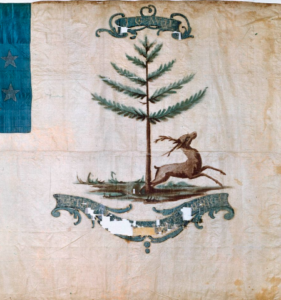
Unknown,"Bucks of America Flag," circa 1785-1786. https://www.digitalcommonwealth.org/search/commonwealth-oai:mc87q412d
A Quiet Life at Home
Middleton shared his home at 5 Pinckney Street on Beacon Hill with Louis Glapion, a French West Indian immigrant and hairdresser. Glapion ran a salon out of their shared residence, which also doubled as a hub for community organizing and early abolitionist gatherings. Although Middleton later married Elsey Marsh in 1781, census data suggests theirs was a modest household of three, and they had no children. The two men lived together for at least two decades, until Glapion’s marriage in 1792, at which point the house was divided. Middleton ultimately outlived Marsh and, in his will, left his possessions to his “true friend Trimstom Babcock” 3. The phrase “true friend” is often one that masks deep emotional or homoerotic bonds during this era.
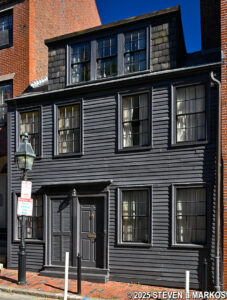
Markos, Steve, “George Middleton House on the Black Heritage Trail in Boston.”Photograph. National Parks Planner, https://npplan.com/parks-by-state/massachusetts-national-parks/boston-african-american-national-historic-site-park-at-a-glance/boston-african-american-national-historic-site-black-heritage-trail/boston-african-american-national-historic-site-george-middleton-house/
Could Middleton’s marriage have been what we now call a “lavender marriage”? The concept of a lavender marriage is a heterosexual marriage of convenience where at least one partner is homosexual, aimed at concealing their sexual orientation from society. These marriages allowed them to maintain a façade of a "normal" life while hiding their true sexual orientation. Historians may never know for certain. But the pattern of intimate male friendships, cohabitation, and domestic partnership, especially with Glapion, suggests a queer dynamic worth examining.
Not all of Middleton’s neighbors embraced his presence. However, Lydia Maria Child’s father, a white abolitionist and neighbor, admired Middleton’s violin playing and horsemanship, but Lydia seemed to have a different perspective than her father that Middleton was “not a very good specimen of the colored man,” calling him “passionate, intemperate, and profane.” 1 These critiques and “coded moral judgments” seem to reflect Child’s discomfort with Middleton's unapologetically independent and unconventional life. His resistance to social norms, whether political, racial, or even with his sexuality, made him a more radical figure than history has often acknowledged.
Middleton later became the third Grand Master of the African Lodge of Freemasons after Prince Hall’s death. He upheld traditions of Black fraternity and mutual aid. Yet his personal life suggests he also carved out queer spaces of care, intimacy, and resistance, long before “LGBTQ” was a known term. Middleton’s life is a reminder that Black queer history is not new. It’s simply been hidden in plain sight, woven through our communities, our homes, and our ongoing fight for liberation.
Edmonia Lewis: Sculpting Freedom, Identity, and Queer Belonging
Born free in 1844 to a father who was of African descent and an immigrant from Haiti and a Chippewa mother, Mary Edmonia Lewis endured the trauma of early orphanhood and racism in education before emerging as one of the first internationally renowned Black sculptors. Edmonia, being one of only a handful of students of color, regularly endured racism. In 1862, two white classmates falsely accused her of poisoning them. Though she was cleared by the university, soon after, a group of white men abducted her, beat her nearly to death, and left her in a frozen field. She barely survived, carrying the trauma and injuries forward. Later accused of stealing art supplies, she left Oberlin without a degree, whether it was by expulsion or choice remains unclear.5
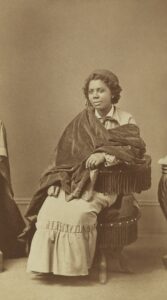
Rocher, Henry. Edmonia Lewis. 1870. Albumen silver print. Wikimedia Commons. https://commons.wikimedia.org/w/index.php?title=File:Edmonia_Lewis.jpg&oldid=401703339.

A Radical Beginning in Boston
Determined to follow her mother’s artistic path, Edmonia moved to Boston in 1864 with no formal training, but a deep and defiant belief that she could make a “stone man” herself.
In Boston, Lewis entered this abolitionist and artistic network thanks to letters of introduction from figures like William Lloyd Garrison and Henry Highland Garnet. Despite rejection by several male sculptors, she eventually trained under Edward Augustus Brackett, a relationship fellow sculptor Anne Whitney (who was likely queer herself) later said ended poorly, though details remain murky. Boston offered Lewis her first public success: a solo exhibition in 1864 and commissions to sculpt heroes like John Brown and Robert Gould Shaw, the white officer who led the famed Black 54th Massachusetts regiment. Lewis witnessed the departure of the 54th Massachusetts Regiment, led by Shaw, and the following year, she received a commission to create several plaster likenesses and a marble bust of Colonel Shaw, who was killed at the Battle of Fort Wagner. Her bust of Shaw, praised by his family, became a turning point, artistically and financially. She became recognized as the nation’s first major black sculptor.
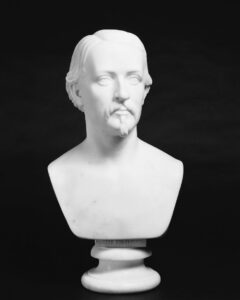
Witness to History: The Robert Gould Shaw/54th Massachusetts Memorial. “Witness to History: The Robert Gould Shaw/54th Massachusetts Memorial,” 2026. https://shaw54th.org/bust-of-robert-gould-shaw-by-edmonia-lewis/.
A Chosen Family in Exile
Despite this success, racial prejudice constrained her American possibilities. In 1866, she left for Rome, where her queerness and her art could flourish. Her 1865 passport stated: “M. Edmonia Lewis is a Black girl sent by subscription to Italy, having displayed great talents as a sculptor.” In Rome, Lewis joined a bold and unconventional community of women artists and intellectuals, many of whom formed queer partnerships and lived outside societal norms. Nicknamed the “Jolly Bachelors,” 6 this group gathered around legendary actress Charlotte Cushman, who lived openly with her partner, sculptor Emma Stebbins, until Cushman died in 1876. Also part of this circle were queer artists like Harriet Hosmer and Anne Whitney, who rejected Victorian gender roles, pursued careers in the arts, and often formed romantic and cohabiting partnerships with other women. These women supported each other emotionally, artistically, and financially in a kind of queer artistic commune in exile.
Lewis’s racial identity as a Black and Indigenous woman complicated and enriched her presence in this space. She remained both inside and at the edges of the Jolly Bachelors, embraced as a sister in art and resistance, but often othered by race and national origin. Her sexuality remains undocumented, but the context of her closest community, one defined by gender nonconformity, chosen family, and queer intimacy, suggests a powerful alignment with their values and lifeways.8 Her very presence abroad was radical, a self-emancipated artist funded by abolitionists, moving beyond the constraints of American respectability politics.
[NEED to insert carousel photos of Lewis’ sculptures]
In 1873, Lewis’s engagement was publicly announced, and in 1875, it was revealed that her fiancé was of the same race as her. No name was given, and no further trace of this relationship exists. The silence surrounding this episode invites speculation.
What remains is Lewis’s lasting integration into a queer world where identity, defiance, and imagination merged, in stone, in community, and in the lives she shaped with her chisel. Though her time in Boston was brief, the city launched Lewis’s career and her escape. Rome gave her freedom to be what America could not yet imagine: a successful Black, Indigenous, and possibly queer woman sculptor, living on her own terms.
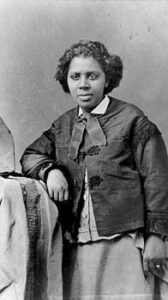
Wikimedia Commons contributors, "File: Edmonia Lewis.jpg," Wikimedia Commons, https://commons.wikimedia.org/w/index.php?title=File:Edmonia_Lewis.jpg&oldid=401703339

Angelina Weld Grimké: Queer Desire in the Harlem Renaissance
Angelina Weld Grimké (1880–1958) was an American playwright, poet, and educator best remembered as part of the Harlem Renaissance of the 1920s. She became the first African American woman to have a play staged with Rachel (1916), a beautiful anti-lynching drama. Her poetry appeared in key anthologies such as Alain Locke’s The New Negro (1925) and Countee Cullen’s Caroling Dusk (1927), positioning her within the era’s flourishing Black cultural movement.6
Yet Grimké’s life and writing are just as notable for what remained unpublished and unspoken: her intense, often thwarted attraction to women, preserved in private letters and poems. In recovering these works, queer and feminist scholars of the 1980s and 1990s reintroduced Grimké as one of the few Black women writers of her era whose work documents same-sex desire.7
Queer Awakening: Friendship, Desire, and the Letters
Born in Boston to a white mother and a mixed-race father, Grimké grew up in a family already legendary in reform circles. Her great-aunts, white abolitionists Angelina and Sarah Grimké, had used their pens to argue for women’s rights and the end of slavery. Her father, Archibald Grimké, was himself the son of a white enslaver and an enslaved woman, and he rose to become a lawyer, political activist, and vice president of the NAACP. Despite being three-quarters white by ancestry, Grimké identified strongly as Black, aligning her work with the struggles of African Americans in an era of Jim Crow violence and segregation.
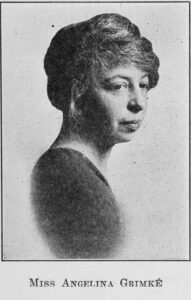
Schomburg Center for Research in Black Culture, Jean Blackwell Hutson Research and Reference Division, The New York Public Library. "Angelina W. Grimké." New York Public Library Digital Collections. https://digitalcollections.nypl.org/items/6fd805a0-c6dc-012f-d1dc-58d385a7bc34
Deeper Dive into Queer Longing
Grimké’s most enduring work lies not only in her published dramas and political writings, but also in the poems she chose not to publish. Many of these explicitly use female pronouns to describe love and longing, revealing a romantic and erotic attraction to women.
- Poems such as A Mona Lisa and When the Green Lies Over the Earth adopt traditionally feminine imagery for the beloved.
- Unpublished works like Caprichosa, To Her of the Cruel Lip, and Ballade to My Lady’s Eyes are written in the voice of a woman spurned by another woman.
Grimké’s emotional life began to take shape in her teenage years through a series of passionate attachments to other young women. While attending the M Street School in Washington, D.C., she formed a close romantic friendship with her classmate Mary Burrill. Letters exchanged between them suggest that such “crushes” were common among college and academy women of the Gilded and Progressive eras, expressing affection through a language of devotion and intimacy.14 Burrill wrote tenderly of missing Grimké, confessing that she longed “to come to meet thee once more… and like an angel bending o’er you breathe into your ear ‘I love you’”.15
Alarmed by Angelina’s emotional independence and possibly by gossip surrounding her relationship with Burrill, Archibald arranged for his daughter to leave Washington and attend Carleton Academy in Northfield, Minnesota.16 There, in 1896, Grimké experienced what scholars consider her first explicitly romantic love for another woman: Mary (Mamie) Edith Karn, a white classmate. Among Grimké’s surviving papers are letters written to Karn on the backs of her physics notes. These letters are remarkable both for their emotional candor and their unguarded expression of queer desire. In one, she wrote:
“Oh Mamie, if you only knew how my heart beats when I think of you and it yearns and pants to gaze, if only for one second, upon your lovely face. If there were any trouble in this wide and wicked world from which I might shield you, how gladly would I do it, if it were even so great a thing as to lay down my life for you.”
In another, she envisioned a shared future that echoed the language of romantic marriage:
“I know you are too young now to become my wife, but I hope, darling, that in a few years you will come to me and be my love, my wife. How my brain whirls, how my pulses leap with joy and madness when I think of those two words, ‘my wife.’”
These letters, written when Grimké was sixteen, reveal an extraordinary early articulation of queer identity. They blur the boundaries between the sentimental conventions of female friendship and the erotic intensity of romantic love. Grimké’s use of the word “wife” places her longing in the context of devotion and partnership rather than fleeting attraction, anticipating the language of lesbian love that would only later emerge in the public sphere.
There is no record that Karn ever responded. Some scholars speculate that Grimké never sent the letters, perhaps fearing rejection or discovery.17 Her subsequent poetry, particularly unpublished works like Caprichosa, To Her of the Cruel Lip, and Ballade to My Lady’s Eyes, returns repeatedly to the image of a woman scorned by another woman. The sense of loss and unreciprocated affection that echoes through these poems suggests that the episode with Karn profoundly shaped Grimké’s inner life and artistic imagination.
Public Voice and Private Silence
Although Grimké’s private writings overflowed with emotional intensity, her public work often masked this interior world. Her play Rachel (1916) channels grief and moral outrage through a political lens, depicting a Black woman who refuses motherhood in protest against racial violence. Her short stories “The Closing Door” and “Goldie,” published in The Birth Control Review, explore similar themes of despair and the impossibility of safety for Black families in a racist society.
Her poetry, by contrast, appears restrained and meditative. Published pieces such as A Mona Lisa and When the Green Lies Over the Earth employ lush imagery and feminine pronouns, signaling desire for women while remaining sufficiently ambiguous to evade censure. Critics once regarded these poems as sentimental or conventional, but later feminist readings have revealed how delicately they encode forbidden longing. As Gloria T. Hull observes, Grimké’s unpublished writings “chronicle a romance which is now dead or record a cruel and unrequited love”. This dual existence of being both publicly respectable but privately yearning reflects the tension that defined Grimké’s life as a queer Black woman in a segregated and heteronormative society.
Schomburg Center for Research in Black Culture, Jean Blackwell Hutson Research and Reference Division, The New York Public Library. "Angelina W. Grimké." New York Public Library Digital Collections. https://digitalcollections.nypl.org/items/6fd805a0-c6dc-012f-d1dc-58d385a7bc34
Later Years & Legacy
After her father died in 1930, Grimké’s already fragile world collapsed. The man who had shaped both her ambitions and her limitations was gone, and she withdrew almost completely from literary and social life. She ceased publishing, avoided correspondence with her Harlem Renaissance peers, and lived quietly in New York until her death on June 10, 1958.
When feminist and queer scholars rediscovered her work in the 1980s and 1990s, they reframed her as not only a Harlem Renaissance writer but also an essential voice in early Black queer literature. Her letters to Mamie Karn and her private poetry stand today as rare, powerful testimonies of love articulated against the grain of race, gender, and respectability. Grimké’s story is one of both silence and survival. The very secrecy that once constrained her has become, for later readers, a site of reclamation and, most importantly, a space where queer Black womanhood can finally speak its name.
Conclusion
The stories in this exhibit expose a deeper truth about the historical record: Blackness and queerness have rarely been allowed to coexist openly within it. For centuries, the forces that shaped official history, white supremacy, respectability politics, and heteronormativity all worked together to decide whose lives were worth documenting and whose complexities were too inconvenient to preserve. When Black people appeared in the archive at all, they were often flattened into symbols of suffering or perseverance; when queer people appeared, their identities were coded, hidden, or erased outright. Those who embodied both were pushed to the margins twice over. Recognizing the intersection of the Black and queer experience requires us to confront the limits of the archive itself. It means admitting that silence is not absence, that euphemism is often evidence, and that intimacy can be a form of resistance as powerful as speeches or statues. It also requires questioning why certain narratives were sanitized, whose comfort that protected, whose humanity it obscured, and how much history we have lost as a result. By looking directly at these intertwined identities, we don’t just recover overlooked figures; we challenge the very framework of how history has been written. These lives remind us that queerness and Blackness have always shaped Boston; not quietly, not marginally, but fundamentally. The work now is to ensure they are no longer treated as footnotes, but as essential threads in the city’s story and in the ongoing project of telling truthfully what America has been and what it might yet become.
Endnotes
- George Middleton, Last Will and Testament, 1815, Suffolk County Probate Records. “Colored Patriots of the American Revolution - Chapter I.” 2025. Usgenealogyexpress.com. 2025. http://www.usgenealogyexpress.com/~bhist/hist_1855_RevSoldiers_colored/hist_1855_RevSoldiers_colored_pg_013_chapt_I.htm.
- Colonel George Middleton – The West End Museum. (2021, November 16). https://thewestendmuseum.org/history/era/west-boston/colonel-george-middleton/
- Staff, P. (2011, October 20). Col. George Middleton: Black Revolutionary War hero. Philadelphia Gay News. https://epgn.com/2011/10/20/16111840-col-george-middleton-black-revolutionary-war-hero/
- George Middleton, Last Will and Testament, 1815, Suffolk County Probate Records. “Colored Patriots of the American Revolution - Chapter I.” 2025. Usgenealogyexpress.com. 2025. http://www.usgenealogyexpress.com/~bhist/hist_1855_RevSoldiers_colored/hist_1855_RevSoldiers_colored_pg_013_chapt_I.htm.
- Rothberg, Emma. 2021. “Edmonia Lewis.” National Women’s History Museum. 2021. https://www.womenshistory.org/education-resources/biographies/edmonia-lewis.
- Rothberg, Emma. 2021. “Edmonia Lewis.” National Women’s History Museum. 2021. https://www.womenshistory.org/education-resources/biographies/edmonia-lewis.
- Martinez-Proctor, Eleanor. 2024. “The Jolly Bachelors of Rome.” Historicnewengland.org. 2024. https://www.historicnewengland.org/the-jolly-bachelors-of-rome/.
- Rothberg, Emma. 2021. “Edmonia Lewis.” National Women’s History Museum. 2021. https://www.womenshistory.org/education-resources/biographies/edmonia-lewis.
- Britannica Editors. "Angelina Weld Grimké." Encyclopedia Britannica, June 6, 2025. https://www.britannica.com/biography/Angelina-Weld-Grimke.
- Genny, Brett, and Beemyn Encyclopedia. “Grimké, Angelina Weld (1880-1958),” n.d. http://www.glbtqarchive.com/literature/grimke_aw_L.pdf.
- Dickson D. Bruce Jr., Archibald Grimké: Portrait of a Black Independent (Baton Rouge: Louisiana State University Press, 1993).
- Britannica Editors. "Angelina Weld Grimké." Encyclopedia Britannica, June 6, 2025. https://www.britannica.com/biography/Angelina-Weld-Grimke.
- Gloria T. Hull, Color, Sex, and Poetry: Three Women Writers of the Harlem Renaissance (Bloomington: Indiana University Press, 1987), 137.
- Rouse, Wendy L. “‘A Very Crushable, Kissable Girl’: Queer Love and the Invention of the Abnormal Girl Among College Women in the Gilded Age and Progressive Era.” The Journal of the Gilded Age and Progressive Era 21, no. 3 (2022): 201–20. https://doi.org/10.1017/S1537781422000147.
- Rouse, Wendy L. “‘A Very Crushable, Kissable Girl’: Queer Love and the Invention of the Abnormal Girl Among College Women in the Gilded Age and Progressive Era.” The Journal of the Gilded Age and Progressive Era 21, no. 3 (2022): 201–20. https://doi.org/10.1017/S1537781422000147.
- Rouse, Wendy L. “‘A Very Crushable, Kissable Girl’: Queer Love and the Invention of the Abnormal Girl Among College Women in the Gilded Age and Progressive Era.” The Journal of the Gilded Age and Progressive Era 21, no. 3 (2022): 201–20. https://doi.org/10.1017/S1537781422000147.
- Genny, Brett, and Beemyn Encyclopedia. “Grimké, Angelina Weld (1880-1958),” n.d. http://www.glbtqarchive.com/literature/grimke_aw_L.pdf.
- Genny, Brett, and Beemyn Encyclopedia. “Grimké, Angelina Weld (1880-1958),” n.d. http://www.glbtqarchive.com/literature/grimke_aw_L.pdf.
- Ann Allen Shockley. Afro-American Women Writers, 1746-1933 : An Anthology and Critical Guide. New York, N.Y., U.S.A.: New American Library, 1989.
- Gloria T. Hull, Color, Sex, and Poetry: Three Women Writers of the Harlem Renaissance (Bloomington: Indiana University Press, 1987), 137.
- Genny, Brett, and Beemyn Encyclopedia. “Grimké, Angelina Weld (1880-1958),” n.d. http://www.glbtqarchive.com/literature/grimke_aw_L.pdf.
Bibliography
Shockley, Ann Allen. Afro-American Women Writers, 1746-1933 : An Anthology and Critical Guide. New York, N.Y., U.S.A.: New American Library, 1989.
Britannica Editors. "Angelina Weld Grimké." Encyclopedia Britannica, June 6, 2025. https://www.britannica.com/biography/Angelina-Weld-Grimke.
Middleton, Colonel George – The West End Museum. (2021, November 16). https://thewestendmuseum.org/history/era/west-boston/colonel-george-middleton/
Dickson D. Bruce Jr., Archibald Grimké: Portrait of a Black Independent (Baton Rouge: Louisiana State University Press, 1993).
Genny, Brett, and Beemyn Encyclopedia. “Grimké, Angelina Weld (1880-1958),” n.d. http://www.glbtqarchive.com/literature/grimke_aw_L.pdf.
Wick, Sharon. “Genealogy Express: Black History and Genealogy.” “Middleton, George. Last Will and Testament, 1815.” Suffolk County Probate Records. “Colored Patriots of the American Revolution - Chapter I.” 2025. Usgenealogyexpress.com. 2025. http://www.usgenealogyexpress.com/~bhist/hist_1855_RevSoldiers_colored/hist_1855_RevSoldiers_colored_pg_013_chapt_I.htm.
Hull, Gloria T. Color, Sex, and Poetry: Three Women Writers of the Harlem Renaissance (Bloomington: Indiana University Press, 1987), 137.
Martinez-Proctor, Eleanor. 2024. “The Jolly Bachelors of Rome.” Historicnewengland.org. 2024. https://www.historicnewengland.org/the-jolly-bachelors-of-rome/.
Rothberg, Emma. 2021. “Edmonia Lewis.” National Women’s History Museum. 2021. https://www.womenshistory.org/education-resources/biographies/edmonia-lewis.
Rouse, Wendy L. “‘A Very Crushable, Kissable Girl’: Queer Love and the Invention of the Abnormal Girl Among College Women in the Gilded Age and Progressive Era.” The Journal of the Gilded Age and Progressive Era 21, no. 3 (2022): 201–20. https://doi.org/10.1017/S1537781422000147.
Staff, P. (2011, October 20). Col. George Middleton: Black Revolutionary War hero. Philadelphia Gay News. https://epgn.com/2011/10/20/16111840-col-george-middleton-black-revolutionary-war-hero/